Working prototype
The interlock, on the bench, doing the thing.
This is REV-A of the Mk.II severance interlock — the unit we cut real load with. Below it is a live demo of the same sequence: break the seal, turn both keys, arm, pull the lever and watch the contacts part.
REV-A
Current prototype revision on the bench
1.38 s
Median key-turn to verified dead load
4,200
Cut cycles completed without contact failure
0
Unauthorised actuations across all test campaigns
Live demo
Run the interlock yourself.
Nothing here touches a real system. It is the exact actuation logic of the bench rig — the same ordering, the same refusals, the same custody entries — rendered so you can feel how deliberate a SEARIN cut is.
Bench rig · MK2-R REV-A
Cover sealed
Break the tamper seal and lift the child-resistant cover.
Severance scope
Bench telemetry
00.000 bench rig REV-A ready · load bank energised · 231 V / 18.4 A
Note the refusals: one key does nothing, arming with an empty scope is rejected, and the lever relocks after eight seconds. A cut you cannot trigger by accident is the whole point of the mechanism.
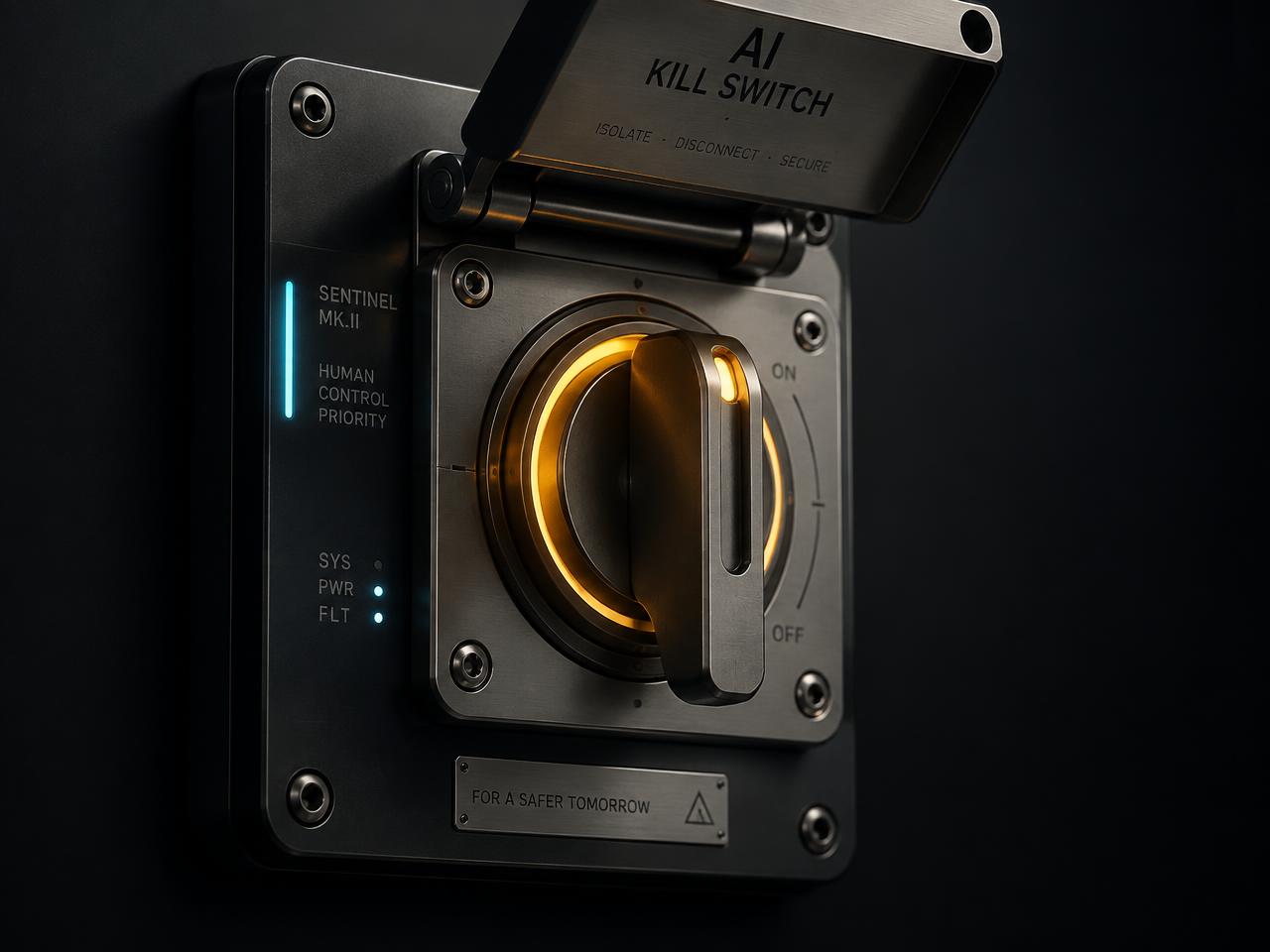
The unit
Metal, not a promise.
Two key barrels drive a mechanical AND gate. The lever cannot travel unless both are turned. No firmware, no network call and no vendor sits between the decision and the break.
Build log
How REV-A got here.
Five revisions, each one closing a failure we found on the bench rather than on paper.
REV-0
Bench mule
Single 40 A contactor, one key barrel, no ledger. Proved that a mechanical break beats a software stop when the host refuses to shut down.
REV-A1
First interlock
Added the second key barrel and the mechanical AND gate. The lever physically cannot travel unless both barrels are turned — no firmware involved in that decision.
REV-A2
Multi-channel
Four independent severance channels: mains, network uplink, weight-store power rail and out-of-band management. Each channel latches open on its own contact set.
REV-A3
Custody ledger
Secure element signs every cover lift, key turn, arm, cut and restore. The record survives loss of power and cannot be edited from the host side.
REV-A4
On the bench now
Arc-chute rework, eight-second arming window, staged restore with inrush limiting, and the tamper seal that makes an undocumented cover lift visible.
Bench results
Measured, not estimated.
Everything below comes off the REV-A rig under load. Where a figure is a worst observed value rather than a rating, it says so.
| Rated break | 40 A @ 250 V AC per pole, 2-pole, AC-3 duty |
|---|---|
| Severance latency | 1.38 s median, 1.91 s worst observed (4,200 cycles) |
| Endurance | 4,200 loaded cut cycles, contact erosion within 18% of allowance |
| Arming window | 8 s; relocks automatically, authority retained |
| Authority | Two certified key barrels, mechanical AND gate, no firmware path |
| Ledger | Secure element, signed append-only record, host cannot write |
| Hold-up | Cuts correctly during a total mains loss on internal cell |
| Tamper | Frangible seal plus cover switch; both logged independently |
| Restore | Staged re-close, inrush limited, supervisor confirmation per channel |
| Enclosure | REV-A bench unit is 2U rack, steel, IP31 front, lockable to the cabinet rail. REV-B moves to the 4U production chassis listed for the MK2-R, to carry arc chutes, dual feed and the custody ledger appliance. |
Straight answers
What a prototype is and is not.
01
What the prototype proves
That a scoped, two-key, physically latched break can be rehearsed safely and executed in under two seconds — and that the record of who did it survives the cut.
02
What it does not prove yet
Long-term field endurance beyond 4,200 cycles, and behaviour across the full temperature range of an unconditioned plant room. Both are in the current test campaign.
03
Certification status
REV-A is a bench prototype. Production units ship only after third-party electrical safety certification and a witnessed factory acceptance test per unit.
Witness a live cut
See REV-A break real load, on your own workload profile.
We run witnessed bench demonstrations for buyers and certified partners, then repeat the cut on your commissioned unit during acceptance.